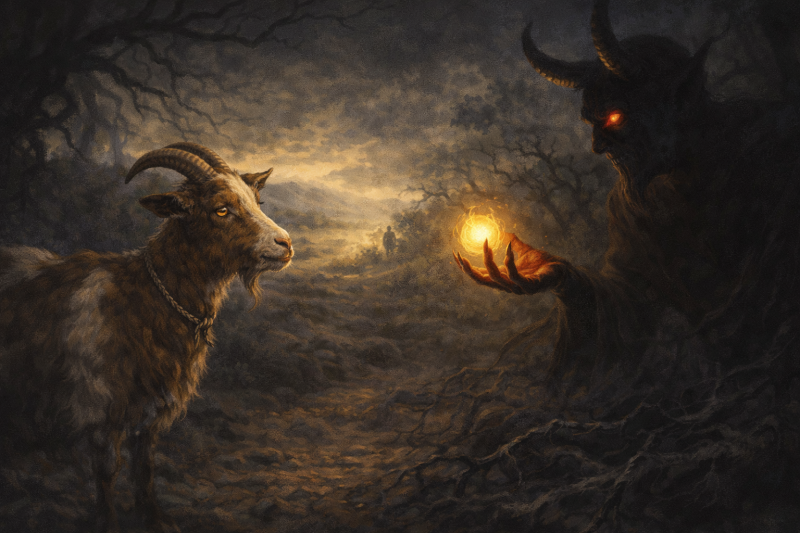
Why Are Goats Often Tied to Evil?

1. Symbolism, Not Identity
In the Bible, animals are often used symbolically to teach lessons about human behavior. When goats appear in negative imagery, it is not because goats are sinful creatures, but because they represented independence, separation, or stubbornness—traits humans struggle with.
God uses what people understand to explain deeper truths.
2. Matthew 25 – The Sheep and the Goats
The strongest association comes from Jesus’ teaching:
“And he shall separate them one from another, as a shepherd divideth his sheep from the goats.”
— Matthew 25:32 (KJV)
This passage is about judgment and fruit, not about goats being evil animals. Goats were commonly separated from sheep at night because they required different care. Jesus used a familiar farming practice to explain spiritual accountability.
The message wasn’t “goats are bad.”
The message was choices matter.
3. The Scapegoat (Leviticus 16)
In the Old Testament, a goat was used in the Day of Atonement ritual:
One goat was sacrificed.
One goat was released into the wilderness, carrying the sins of the people.
This scapegoat symbolized the removal of sin—not evil itself. Ironically, this is one of the most redemptive uses of a goat in Scripture.
4. Later Cultural Distortion
The darker image of goats comes mostly from post-biblical art and folklore, not Scripture:
-
Medieval art linked goats with pagan imagery
-
Horns were wrongly equated with rebellion
-
Satanic imagery borrowed animal features for shock value
None of this comes from biblical teaching.
5. Jesus Spoke of Goats Neutrally
Jesus never calls goats evil animals. He references them matter-of-factly, alongside sheep, to illustrate discernment—not condemnation.
Goats appear:
-
In sacrifices
-
In parables
-
In everyday agrarian life
They were valuable livestock, not cursed creatures.
The Truth in Simple Terms
-
Sheep = followers
-
Goats = wanderers
-
Both = human
-
Both = in need of a Shepherd
“All we like sheep have gone astray…”
— Isaiah 53:6 (KJV)
Devotion: What the Heart Feeds

Just like goats and sheep graze on the pasture, our hearts graze on thoughts, habits, and choices. Scripture reminds us:
“For out of the heart proceed evil thoughts, murders, adulteries, fornications, thefts, false witness, blasphemies.” — Matthew 15:19 (KJV)
“Keep thy heart with all diligence; for out of it are the issues of life.” — Proverbs 4:23 (KJV)
The Bible doesn’t blame the goats or sheep for wandering — it points to the heart of the shepherded. We are the ones who must guard what we feed ourselves—physically, emotionally, and spiritually.
Some days we are like sheep, following the Shepherd’s voice and resting in His guidance. Other days we are like goats, curious, independent, or distracted. Neither is condemnation — both are opportunities to return to the pasture.
“All we like sheep have gone astray; we have turned every one to his own way.” — Isaiah 53:6 (KJV)
Little Grazing Goat is about noticing where we wander, choosing what brings life, and staying near the Shepherd. Every step back to Him is a grazing step toward health, peace, and faithfulness.
Reflection:
-
What am I feeding my heart today?
-
Am I following or wandering?
-
How can I take one step closer to the Shepherd this week?
Wandering Hearts, Wandering Goats
Goats often appear as troublemakers in movies or cartoons, but Scripture shows that wandering doesn’t equal evil. Like goats, we all wander—sometimes in our habits, our choices, or even our faith. I see myself in both the sheep and the goat: some days I follow the Shepherd closely, other days I graze where I shouldn’t.
“All we like sheep have gone astray; we have turned every one to his own way.” — Isaiah 53:6 (KJV)
This site is about noticing where we wander, learning to return to the Shepherd, and choosing what brings life—one step at a time.
Why Jesus Chose to Die
Jesus did not die because He was forced.
He died because He chose to.
He chose the cross knowing the cost.
He chose nails so we wouldn’t have to carry our guilt forever.
He chose suffering so the broken would never suffer alone.
At the cross, Jesus took the place of the wandering, the stubborn, the ashamed.
The lost sheep.
The overlooked goat.
The sinner who never quite fits in.
“But God demonstrates His own love for us in this: While we were still sinners, Christ died for us.” — Romans 5:8
He stood where we deserved to stand.
He bled where we should have bled.
And even in His pain, He made room at His feet for the small, the weak, and the crushed in spirit.
That is why we come close.
That is why we kneel.
Not because we are worthy—
but because He chose to make us His
